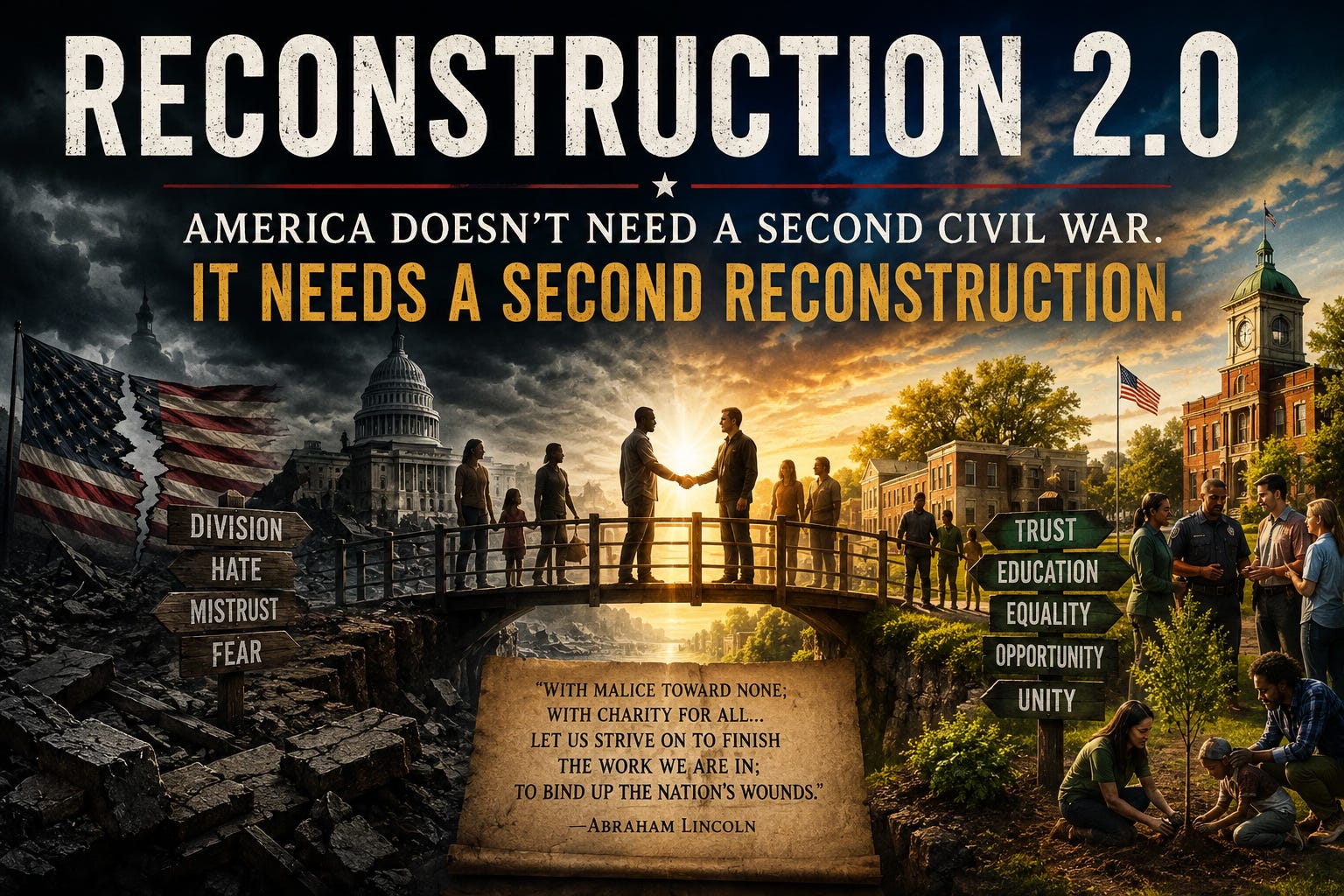
Reconstruction 2.0
America Doesn’t Need a Second Civil War. It Needs a Second Reconstruction.

As a local Village President, I typically write about local government, civic leadership, and community issues rather than national politics.
However, one thing public service has taught me is that local government is where trust in America is either rebuilt or broken. While the division we see today may dominate the national stage, the future of this country will ultimately be shaped in local communities across the nation.
I write this article not as a national political figure, but as a local public servant who believes America may once again be approaching a moment that calls not for another conflict—but for another Reconstruction.
There are moments in American history when the nation becomes so divided that simply “moving on” is no longer enough.
The Civil War was one of those moments.
Today, many Americans feel we are approaching another.
Political division has deepened. Trust in institutions has weakened. Citizens increasingly view one another not as neighbors with different opinions, but as enemies. Families, communities, schools, workplaces, and even local governments feel the strain of constant national conflict.
The wounds of the past were never fully healed.
And now, many believe those wounds are reopening.
In many ways, the United States doesn’t need another revolution.
It needs another Reconstruction.
Not a reconstruction of buildings or battlefields—but a reconstruction of civic trust, equal citizenship, local democracy, and national unity.
To understand why, we must first look backward.
Lincoln’s Vision for Reconstruction
Near the end of the Civil War, Abraham Lincoln began preparing for what came after the fighting stopped.
Lincoln understood something many leaders throughout history failed to understand:
Winning a war isn’t the same as rebuilding a nation.
In his Second Inaugural Address in March of 1865, Lincoln didn’t call for vengeance. He didn’t speak of humiliation or domination. Instead, he delivered one of the most remarkable speeches in American history:
“With malice toward none; with charity for all… let us strive on to finish the work we are in; to bind up the nation’s wounds.”
Lincoln’s Reconstruction plan was rooted in reunification.
Through what became known as the “Ten Percent Plan,” Southern states could begin rebuilding their governments once a small percentage of citizens swore loyalty to the Union and accepted the abolition of slavery.
To many critics, Lincoln’s plan seemed too lenient.
But Lincoln’s goal was larger than punishment.
He wanted to prevent permanent national fracture.
At the same time, Lincoln’s views on equality were evolving rapidly.
By the final months of his life, he had moved beyond simply preserving the Union. He had begun publicly supporting limited voting rights for Black Americans, particularly educated Black men and Black veterans who had served the Union cause.
That evolution mattered.
Lincoln increasingly understood that freedom without citizenship was incomplete.
The Reconstruction That Actually Happened
Everything changed on April 14, 1865.
Lincoln was assassinated just days after Confederate General Robert E. Lee surrendered at Appomattox.
His death altered the course of Reconstruction and perhaps American history itself.
Lincoln’s successor, Andrew Johnson, approached Reconstruction very differently.
Johnson quickly restored power to many former Confederate leaders and plantation elites. Southern states soon enacted “Black Codes,” laws designed to restrict the rights and freedoms of newly emancipated Black Americans.
Congress responded aggressively.
The nation entered a far more confrontational period known as the Reconstruction Era.
Federal troops occupied Southern states. Reconstruction produced transformative constitutional changes, including the 13th, 14th, and 15th Amendments, but it also unleashed intense resistance, violence, and political instability.
Groups like the Ku Klux Klan emerged to violently resist equality and federal authority.
Eventually, Reconstruction collapsed politically in 1877.
Many of its promises remained unfinished.
For generations afterward, segregation, voter suppression, and institutional inequality continued across large parts of the country.
The Civil War ended militarily.
But America never fully completed the civic reconstruction Lincoln envisioned.
The Unfinished Reconstruction
Today, the United States faces a different kind of fracture.
The conflict is not North versus South.
It is trust versus distrust.
Truth versus misinformation.
Citizenship versus tribalism.
Many Americans today (across the political spectrum) believe powerful institutions no longer serve ordinary people. Others fear democratic norms themselves are eroding. Some believe wealthy political and corporate interests manipulate public anger for power, influence, or profit.
Ironically, Lincoln himself often framed secession as ordinary Southerners being manipulated by wealthy elites whose political and economic interests depended upon division.
Whether one agrees with modern political comparisons or not, the underlying concern remains familiar:
A divided population is easier to control than a united one.
The danger is not disagreement.
Disagreement is essential to democracy.
The danger is when Americans stop seeing one another as fellow citizens altogether.
That is when republics begin to fail.
America Needs a Reconstruction 2.0
The United States doesn’t need another Civil War.
It needs a modern Reconstruction.
A Reconstruction 2.0.
Not one built on revenge or ideological domination, but one built on civic renewal, equal citizenship, institutional trust, and national repair.
The first Reconstruction attempted to rebuild a nation physically and constitutionally after slavery and civil war.
A modern Reconstruction must rebuild America socially, civically, and institutionally after decades of polarization, distrust, and fragmentation.
This begins not in Washington alone, but in local communities.
What Reconstruction 2.0 Could Look Like
A modern Reconstruction should rest on five core pillars:
1. Civic Education Reconstruction
Millions of Americans don’t fully understand how government works, where authority exists, or how citizens can effectively participate.
This vacuum creates confusion, frustration, and vulnerability to manipulation.
America needs plain-language civic education focused on:
Local government
Constitutional rights
Public meetings
Budgets
Voting systems
Media literacy
Responsible citizenship
An informed citizen is far harder to divide.
2. Equal Citizenship Reconstruction
The promise of equal protection under the law remains unfinished.
Reconstruction 2.0 should strengthen:
Voting access
Civil rights protections
Government accountability
Fair treatment under public institutions
Equal access to opportunity
Equality under the law must remain foundational to the American experiment.
3. Local Democracy Reconstruction
National politics dominate headlines, but local government shapes daily life more directly than most federal policy.
Local democracy must become functional, transparent, and understandable again.
That means:
Better public engagement
Respectful public meetings
Ethical leadership
Clear communication
Properly trained boards and commissions
Transparent decision-making
Healing begins closest to home.
4. Economic Reconstruction
Economic insecurity fuels political instability.
Communities that feel abandoned become vulnerable to extremism, resentment, and division.
A modern Reconstruction should focus on:
Workforce development
Apprenticeships
Infrastructure
Small business growth
Trade education
Community investment
Economic dignity strengthens democratic stability.
5. National Reconciliation Reconstruction
America must rediscover how to disagree without hatred.
This doesn’t mean abandoning convictions.
It means rejecting the idea that political opposition makes someone less American.
Reconstruction 2.0 should encourage:
Civil discourse
Community dialogue
Historical education
Shared civic identity
Respectful disagreement
Democracy requires conflict.
But it also requires restraint.
Lincoln’s Greatest Lesson
Lincoln’s greatest contribution may not have been simply preserving the Union.
It may have been recognizing that nations cannot survive indefinitely through humiliation, fear, revenge, or permanent internal hatred.
He understood that a republic depends upon citizens continuing to see one another as part of the same national story.
America today desperately needs leaders, educators, veterans, public servants, labor leaders, teachers, clergy, journalists, and ordinary citizens willing to rebuild that shared story.
Not through slogans.
Not through outrage.
But through civic reconstruction.
The work of Reconstruction was never truly finished.
Perhaps this generation’s responsibility is not to relive the divisions of the past,
but finally to complete the healing Lincoln hoped for.
And perhaps the greatest lesson Lincoln left behind is this:
America doesn’t need a second Civil War.
It needs a second Reconstruction.